
Series Editor: Theodore Levin & Jonas Otterbeck
The Music & Performance in Muslim Contexts (MPMC) is a joint series with the Aga Khan Music Programme and published in association with Edinburgh University Press which presents innovative scholarship in music, dance, theatre and other performative practices and varieties of expressive culture inspired or shaped by Muslim artistic, cultural, intellectual, religious and social heritage, including in new creative forms. Bringing together outstanding new work by leading scholars from a variety of disciplines across the humanities and social sciences, the series embraces contemporary and historical cultural spheres both within Muslim-majority societies and in diasporic subcultures and micro-cultures around the world.
-
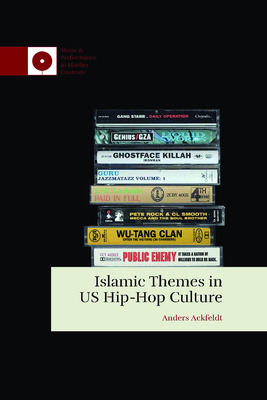
Islamic Themes in US Hip-Hop Culture
Anders Ackfeldt
Explores how Islam is produced in American hip-hop culture by both Muslims and non-Muslims
Islam has been a part of hip-hop culture since it sprang from New York’s street culture in the 1970s. Today hip-hop has evolved into a global artform with a diversity of Muslim Islamic discourses expressed. Using tools from the field of social semiotics, this book examines how Islamic themes feature in US hip-hop culture, maintaining a particular awareness that both Muslims as well as non-Muslims participate in their production.
Anders Ackfeldt analyses a collection of lyrics, sounds and images to show how Islamic themes are featured in US hip-hop culture. Furthering our understanding of the semiotic associations and functions of Islamic themes, the text demonstrates that Muslims as well as non-Muslims have used these themes in their artistic productions throughout the history of African American music-making. Examining the use of Islamic semiotic resources in gospel, blues and jazz through to hip-hop, Ackfeldt reveals a historical continuity running through US musical culture – and one which is also often connected to African American religious initiatives and African American empowerment politics.
-
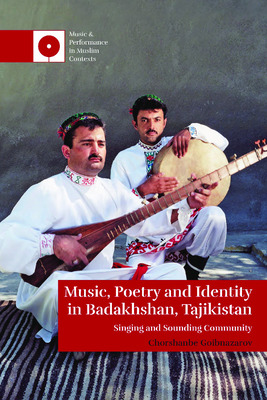
Music, Poetry and Identity in Badakshan, Tajikistan: Singing and Sounding Community
Chorshanbe Goibnazarov
An illuminating account of Ismaili music, spiritual poetry and social change in Badakhshan.
In the riverine valleys of the Pamir Mountains of Tajik Badakhshan, a thriving millennium-old community of Nizari Ismaili Muslims created a unique spiritual culture in which the performance of music and poetry plays a central role. This book focuses on the central musical and poetic tradition of the Pamiri Ismailis, qasīda-khonī (also known as maddo), tracing its origins, evolution, delocalisation and relocation.
This book introduces readers to leading performers of qasīda-khonī and to the Ismaili gnosis that inspires its music and poetry.
• Based on six years of fieldwork
• Illuminates a little-known and fragile musical tradition as it faces the challenges of secularisation, globalisation and politicisation of Pamiri culture
• Contributes to the ongoing debate about the licitness of music in Islam and demonstrates that music is part of the everyday life of Pamiri Ismaili Muslims, inseparably linking religious and secular dimensions of their lives
-
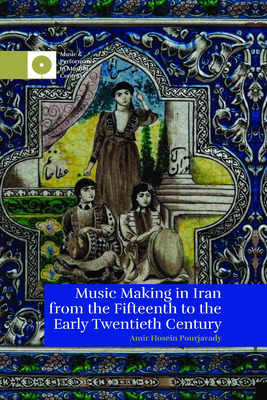
Music Making in Iran from the 15th to the Early 20th Century
Amir Hosein Pourjavady
Music Making in Iran looks at the change and evolution of music in Iran from both social and theoretical perspectives.
Amir Hosein Pourjavady scrutinises the emergence and development of modal entities, rules for modulation, the formation of court repertoires, the progress of rhythmic structures, vocal and instrumental genres and forms of composition. Through this lens, Hosein investigates how Iranian music has been impacted by Western influence, socio-political developments and contact with other musical cultures.
Based on primary sources, the book reveals many new discoveries in its examination of music making during this period, including its centres of patronage, the social organisation of musicians, courtesan and concubine culture and performance contexts.
-
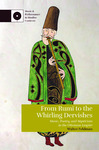
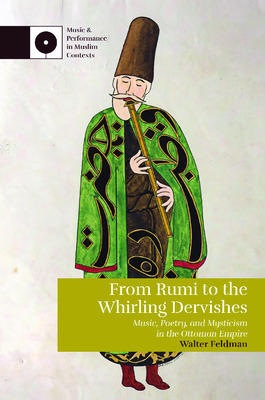
From Rumi to the Whirling Dervishes: Music, Poetry and Mysticism in the Ottoman Empire
Walter Feldman
Mevlana Jalaluddin Rumi, whose life and mystical poetry provided the inspiration for the Mevlevi Sufi order, is one of the world's best-known poets.
Yet the centuries-long musical tradition cultivated by the Mevleviye remains much less known. In this deeply researched book, renowned scholar Walter Feldman traces the historical development of Mevlevi music and brings to light the remarkable musical and mystical aesthetics of the Mevlevi ayin – the instrumental and vocal accompaniment to the sublime ceremony of the 'Whirling' Dervishes.
This accessible introduction to the relationship between music and the performative elements of Sufi practice presents the biographies of the principal Mevlevi musicians, showing both their creation of the music of the ayin and their key role in the development of Ottoman court music. It also includes numerous original translations of Turkish verse by major Mevlevi poets and presents music examples with explanation, both in the book and freely available on the Aga Khan Music Programme website.
-
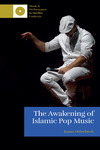
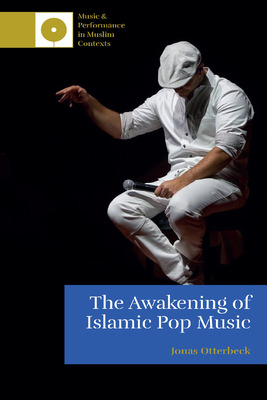
The Awakening of Islamic Pop Music
Jonas Otterbeck
Awakening – an Islamic media company formed in London – has created the soundtrack to many Muslim lives during the last two decades. It has produced three superstars (Sami Yusuf, Maher Zain and Harris J.) among a host of other artists. As the company celebrates their first 20 years in the industry, Jonas Otterbeck examines their remarkable rise to success and their established reputation as one of the most important global enterprises producing pop music inspired by Islam.
Otterbeck thoroughly describes the history and development of new Islamic popular music genres, in particular pop-nashid and Islamic pop, for the first time. He argues that Awakening – a company with the ambition to portray itself as Islamic – is best understood in relation to the ethical turn in Islamic thinking. In analysing the turn to ethics, he explores how the Islamic pop industry is, in effect, altering the very formulations of Islamic thought.
Closely examining the ethical masculinity of the Awakening artists, alongside their personas in songs, on stage and on social media, the book analyses how popular culture and the creative arts challenge Islamic (re)thinking.